
UNISPHERE SELECTED BY EASA TO SHAPE HIGHER AIRSPACE OPERATIONS
UNISPHERE SELECTED BY EASA TO SHAPE HIGHER AIRSPACE OPERATIONS
Press Release
Press Release
About the project
About the project
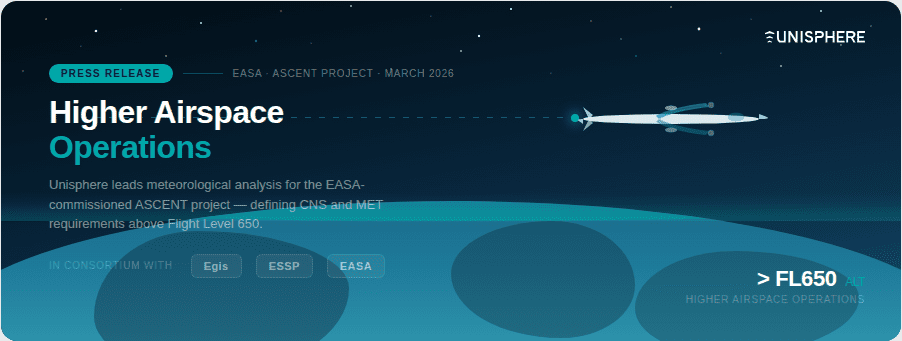
Unisphere has been selected as part of a consortium commissioned by EASA to help develop the regulatory framework for Higher Airspace Operations (HAO) in Europe.
Together with consortium leader Egis and the European Satellite Services Provider (ESSP), Unisphere will contribute its weather intelligence expertise to the ASCENT project.
Within the consortium, Unisphere leads the analysis of meteorological requirements for operations above Flight Level 650 – a zone where standard forecasting models are insufficient and specialised understanding of stratospheric and space weather phenomena becomes critical.
ASCENT (Assessment of System Capabilities and Environmental Needs for higher-airspace Traffic) evaluates communications, navigation and surveillance (CNS), meteorological and space weather service requirements for operations at very high altitudes.
The goal is a clear picture of the current landscape and the future service ecosystem needed to accommodate sub-orbital flights, high-altitude unmanned aircraft systems (HAPS) and supersonic operations.
Unisphere has been selected as part of a consortium commissioned by EASA to help develop the regulatory framework for Higher Airspace Operations (HAO) in Europe.
Together with consortium leader Egis and the European Satellite Services Provider (ESSP), Unisphere will contribute its weather intelligence expertise to the ASCENT project.
Within the consortium, Unisphere leads the analysis of meteorological requirements for operations above Flight Level 650 – a zone where standard forecasting models are insufficient and specialised understanding of stratospheric and space weather phenomena becomes critical.
ASCENT (Assessment of System Capabilities and Environmental Needs for higher-airspace Traffic) evaluates communications, navigation and surveillance (CNS), meteorological and space weather service requirements for operations at very high altitudes.
The goal is a clear picture of the current landscape and the future service ecosystem needed to accommodate sub-orbital flights, high-altitude unmanned aircraft systems (HAPS) and supersonic operations.
The consotrium will specifically:
The consotrium will specifically:
● Develop an in-depth understanding of existing capabilities that can support HAO
● Identify gaps, limitations and safety risks in current CNS, MET and space weather capabilities
● Formulate recommendations for alternative solutions and mitigation measures
● Assess the economic and financial implications of the proposed options
● Engage stakeholders and disseminate findings to support HAO development across Europe
● Develop an in-depth understanding of existing capabilities that can support HAO
● Identify gaps, limitations and safety risks in current CNS, MET and space weather capabilities
● Formulate recommendations for alternative solutions and mitigation measures
● Assess the economic and financial implications of the proposed options
● Engage stakeholders and disseminate findings to support HAO development across Europe
Higher Airspace Operations demand reliable and highly specialised meteorological services. We are delighted to work alongside Egis and EASE to help define the service capabilities and data frameworks needed to support emerging activities such as airship missions, balloon and rocket launches, and supersonic flights.

Christoph Schlettig
Unisphere CEO
Higher Airspace Operations demand reliable and highly specialised meteorological services. We are delighted to work alongside Egis and EASE to help define the service capabilities and data frameworks needed to support emerging activities such as airship missions, balloon and rocket launches, and supersonic flights.
Read the full press release by Egis: EASA chooses Egis, Unisphere and ESSP to advance Higher Airspace Operations
Read the full press release by Egis: EASA chooses Egis, Unisphere and ESSP to advance Higher Airspace Operations